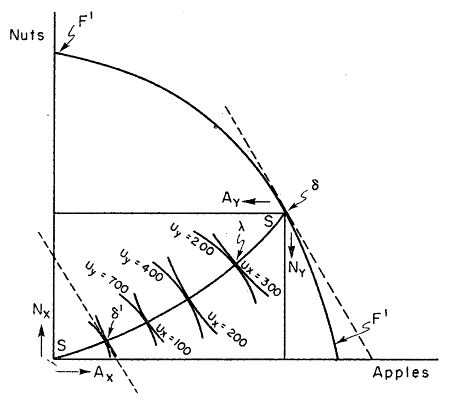
The Lausanne School of mathematical general equilibrium theory was initiated by Léon Walras and Vilfredo Pareto at the University of Lausanne around the turn of the century.
In many respects, the theoretical system of the Lausanne School disappeared under the weight of the Marshallian orthodoxy in England and the Historical orthodoxy on much of the Continent. Even so, it influenced many prominent economists at the time - such as Knut Wicksell and Irving Fisher.
It has been claimed that the Lausanne system was resurrected by Gustav Cassel in 1918 - creating what has been referred to the Walras-Cassel system of G.E.. Cassel's work sparked a small revival among scattered economists on the Continent which led, in turn, led to the formation of the Vienna Colloquium in the 1930s around Karl Menger where mathematicians and economists addressed the questions originally posed by the original Lausanne School through Cassel. Another important development at Vienna was the resurrection of "Classical" General Equilibrium theory in linear systems of equations under under von Neumann and, subsequently, Kantorovich and Leontief.
There was a simultaneous resurrection of Walrasian theory around Robbins' LSE in the 1930s - particularly as found in the work of the young John Hicks.
The mathematical economics movement became the modern "Neo-Walrasian" or "General Equilibrium" school after it immigrated to the United States in the 1930s and 1940s and was reinvigorated, explored and axiomatically formalized into a coherent theory by the host of mathematically-inclined economists such as Koopmans, Arrow and Debreu at the Cowles Commission in Chicago.
For more details, consult the linked essay on Walrasian General Equilibrium Theory
The University of Lausanne
The Founder
Passing the Walrasian Torch, 1910-1950
HET Home Page |
Alphabetical Index |
Schools of Thought |
GF Surveys and Essays |
HET Web Links |